
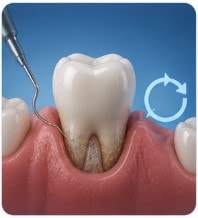
Scaling and root planing is a non-surgical deep cleaning that removes tartar buildup and bacterial deposits from below the gumline. It is the primary treatment for periodontitis and is typically done in two appointments — one side of the mouth at a time.
What You'll Learn
What Is Scaling and Root Planing?
Scaling and root planing — often called a deep cleaning — is a two-part procedure used to treat periodontitis, the more advanced stage of gum disease. Unlike a regular cleaning that focuses on the surfaces of your teeth above and just below the gumline, scaling and root planing goes deeper.
Scaling removes tartar (hardened plaque) and bacterial deposits from the tooth surfaces and from the pockets that form between the teeth and gums when gum disease is present. Root planing smooths the root surfaces of the teeth, which helps the gums reattach and makes it harder for bacteria to accumulate in the future.
The procedure is performed with specialized instruments — either hand scalers or an ultrasonic device that uses vibration and water to break up deposits. Most patients receive local anesthesia so the area is numb throughout.
How Is It Different From a Regular Cleaning?
A standard prophylaxis (regular cleaning) removes plaque and tartar from the visible surfaces of your teeth and just below the gumline — typically within 1–3 mm of the gum margin. It is a preventive procedure for patients with healthy gums or mild gingivitis.
Scaling and root planing goes significantly deeper — into pockets that may be 4 mm or more below the gumline. These pockets form when gum disease causes the gum tissue to pull away from the tooth. Bacteria colonize these pockets, and a regular cleaning cannot reach them.
Your dentist measures your gum pockets at each exam using a small probe. Pocket depths of 4 mm or more, combined with signs of bone loss or bleeding, typically indicate that a deep cleaning is needed rather than a standard cleaning.
What to Expect During the Procedure
Scaling and root planing is typically divided into two appointments — one for the right side of the mouth and one for the left. This allows the anesthesia to wear off on one side while the other is treated, and gives the gums time to begin healing.
At each appointment, local anesthesia is administered to numb the gums and teeth in the treatment area. The dentist or hygienist uses scalers to remove tartar and deposits from below the gumline. Root surfaces are smoothed to remove rough areas where bacteria can cling. The area is rinsed thoroughly.
Each appointment typically takes 45–90 minutes depending on the severity of the disease and the number of teeth involved. Some patients also receive an antibiotic gel placed directly into the pockets after scaling to help eliminate remaining bacteria.
Recovery and What to Expect Afterward
After scaling and root planing, it is normal to experience soreness and tenderness in the gums for 2–5 days, sensitivity to hot and cold, and minor bleeding when brushing for the first few days. Gums may also appear to have receded slightly — this is actually the swelling going down.
To support healing: eat soft foods for the first 24–48 hours, avoid very hot or very cold foods and beverages, rinse gently with warm salt water, continue brushing and flossing carefully, and avoid smoking, which significantly impairs healing.
A follow-up appointment is typically scheduled 4–6 weeks later to measure pocket depths and assess how well the gums have responded to treatment.
Frequently Asked Questions
Ready to Treat Your Gum Disease?
Scaling and root planing is the most effective non-surgical treatment for periodontitis. Our team will assess your gum health and walk you through every step.