
Quick Answer
Yes — digital X-rays are better in most measurable ways. They use 70–80% less radiation than film, produce instant images that can be enlarged and adjusted, are easier to store and share, and eliminate the need for chemical processing. Most modern dental offices use digital X-rays exclusively.
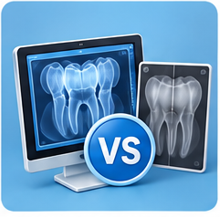
Digital vs. Traditional X-Rays: Side-by-Side
| Feature | Digital X-Rays | Traditional Film |
|---|---|---|
| Radiation dose | 70–80% less than film | Higher baseline dose |
| Image availability | Instant — seconds | 5–10 min to develop |
| Image quality | High-res, adjustable | Fixed, cannot enhance |
| Storage | Digital files, cloud | Physical film packets |
| Sharing | Instant electronic transfer | Physical or re-take |
| Environmental impact | No chemical processing | Requires developer chemicals |
| Patient comfort | Slightly thicker sensor | Thinner, more flexible |
Key Advantages of Digital X-Rays
Lower radiation: Digital sensors require far less X-ray exposure to produce a clear image. This is especially meaningful for children and patients who need frequent imaging.
Instant results: Images appear on the monitor within seconds. Your dentist can review findings with you in real time during the appointment.
Enhanced viewing: Digital images can be zoomed, brightened, or adjusted for contrast to highlight specific areas. This can improve the detection of early cavities and subtle bone changes.
Easy sharing: Digital X-rays can be sent electronically to specialists, insurance companies, or other dental offices instantly — no re-taking X-rays when you change providers.
No chemicals: Film X-rays require developer and fixer chemicals that must be disposed of carefully. Digital X-rays eliminate this entirely.
Frequently Asked Questions
We Use Digital X-Rays at Every Visit
Our office uses the latest digital imaging technology to keep your radiation exposure low and give you the clearest possible view of your dental health.